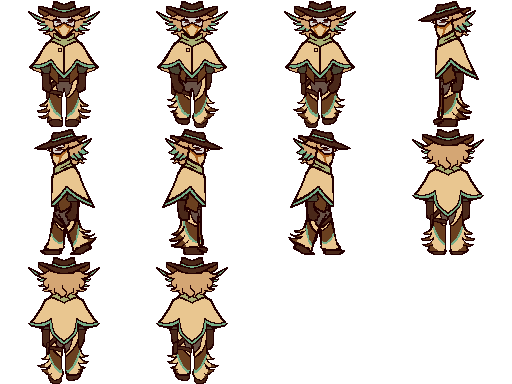
Case Study: DustSoul

“DustSoul” is a 2D first-person narrative adventure game that follows the story of Yonder, a drifter-type cowboy that is breaking away from the identity that has been decided for them and finding the strength to commit to a new path. This game seeks to evoke a sense of vulnerability players can engage with and relate back to their own experiences regarding their sense of self, primarily through art and visual design. This project is intended to be a vertical slice/”proof of concept” for the full version of the game, which will start being produced during the summer of 2026.
DustSoul is my MADD major capstone project, completed from early October to late March. I worked on this project in collaboration with Kaitlyn Goretski, who helped with narrative, music and sound design, and programming. I worked on art/creative direction, producing art assets, and programming. Kaitlyn and I first started talking about DustSoul around 2 years ago, but didn’t begin actually making the game until my capstone class started. We were initially inspired to make the game to get more experience in our respective disciplines within game design, and to learn more about Unity through the process of making. As we kept discussing the main concept and creative direction we wanted to take, we found ourselves constantly referring back to this topic of struggling to express (or reclaim) a sense of self throughout different personal experiences we’ve had. We concluded that we both wanted to explore the struggle of people who have, through oppression, religion, or circumstance, been robbed of their sense of self. We wanted our game to speak to that feeling by providing a raw, vulnerable experience that players can relate to, see themselves in, and use as both comfort and inspiration.
I was particularly interested in seeing how the art direction of our game could be pushed to best serve this purpose; I wanted this game to both feel and look like something only a human could make due to the “sense of self” theme we wanted to explore. I wanted the art pieces and other visual assets to contain artifacts of human presence, such as line work that hasn't fully been cleaned up or parts of the original sketch for a piece of work still being visible. We chose to go with a “wild-west” aesthetic because we thought that the “typical” ideas the image of a cowboy evokes fit well with our theme–we thought the “lone drifter” archetype spoke well to this idea of wanting to forge your own path and express your identity, and how lonely that could feel sometimes. Furthermore, we thought there was a lot of content we could extract from this aesthetic to turn into different aspects of our game–such as having the fast-paced nature of cowboy duels be reflected in the combat of the game through Quick-Time Events. (We also just really like cowboys and the wild west aesthetic).
Before we started working on producing DustSoul, Kaitlyn and I laid out our specifications and expectations for the project in a design document and production plan. We specified the exact content we thought was reasonable to make within the time frame we had to work with, then set milestones for what we should have done on specific dates (completed in sprints), and made a list of tasks that would get us to each milestone. We also planned playtest sessions to get other people’s feedback, and wrote playtest guiding documents to concretely specify what we wanted to test and what criteria we would evaluate it with. Once we had all of this groundwork laid out, we started discussing and making first drafts of the overarching narrative, UI/UX design, and art direction specifications in order to establish a clear feel for the game and make sure we were hitting a look that fit with the themes we wanted to explore. During this process, I spent time gathering references (which included screenshots of other games, work from artists I admired, color swatches I thought fit our western aesthetic, etc.) and analyzing what exactly I liked about these references and why I thought they were effective, in order to guide my process when creating the framework for the visuals of DustSoul. I was able to test the visuals I came up with during our first playtest, where I got feedback from my peers about what resonated with them and what didn’t.
After establishing our visuals and narrative for the scope of our vertical slice, we were able to start more intense production. I took some time to read up on the Unity docs and search for tutorials that I anticipated needing ahead of time to best prepare myself for when I’d inevitably need to troubleshoot my implementation of something in the engine. Although I’d worked on other games before (and took a class that required us to make an educational game in Unity), there was a large amount of features that we would need to implement for DustSoul that I didn’t have experience programming or implementing in-engine before (for example, implementing a 4 directional walk cycle for the main character, and also for their companion that follows them). I think my limited exposure to Unity was one of the biggest challenges I faced throughout the course of production, but I am happy with how much I was able to learn in a short amount of time. I think the most valuable skill I got to improve was being able to interpret different error messages that appeared in the console, and developing a sense of where to look and what things to try first before searching the internet hoping somebody else had run into the same problem.